- About project
- Collections
- Indexes
- Recently viewed
-
RCIN Repositories
-
 INSTYTUT ARCHEOLOGII I ETNOLOGII POLSKIEJ AKADEMII NAUK
-
 INSTYTUT BADAŃ LITERACKICH POLSKIEJ AKADEMII NAUK
-
 INSTYTUT BADAWCZY LEŚNICTWA
-
 INSTYTUT BIOLOGII DOŚWIADCZALNEJ IM. MARCELEGO NENCKIEGO POLSKIEJ AKADEMII NAUK
-
 INSTYTUT BIOLOGII SSAKÓW POLSKIEJ AKADEMII NAUK
-
 INSTYTUT CHEMII FIZYCZNEJ PAN
-
 INSTYTUT CHEMII ORGANICZNEJ PAN
-
 INSTYTUT FILOZOFII I SOCJOLOGII PAN
-
 INSTYTUT GEOGRAFII I PRZESTRZENNEGO ZAGOSPODAROWANIA PAN
-
 INSTYTUT HISTORII im. TADEUSZA MANTEUFFLA POLSKIEJ AKADEMII NAUK
-
 INSTYTUT JĘZYKA POLSKIEGO POLSKIEJ AKADEMII NAUK
-
 INSTYTUT MATEMATYCZNY PAN
-
 INSTYTUT MEDYCYNY DOŚWIADCZALNEJ I KLINICZNEJ IM.MIROSŁAWA MOSSAKOWSKIEGO POLSKIEJ AKADEMII NAUK
-
 INSTYTUT PODSTAWOWYCH PROBLEMÓW TECHNIKI PAN
-
 INSTYTUT SLAWISTYKI PAN
-
 SIEĆ BADAWCZA ŁUKASIEWICZ - INSTYTUT TECHNOLOGII MATERIAŁÓW ELEKTRONICZNYCH
-
 MUZEUM I INSTYTUT ZOOLOGII POLSKIEJ AKADEMII NAUK
-
 INSTYTUT BADAŃ SYSTEMOWYCH PAN
-
 INSTYTUT BOTANIKI IM. WŁADYSŁAWA SZAFERA POLSKIEJ AKADEMII NAUK
-
- Search in all Repository
- Literature and maps
- Archeology
- Mills database
- Natural sciences
Advanced search
Advanced search
Advanced search
Advanced search
Advanced search

Object
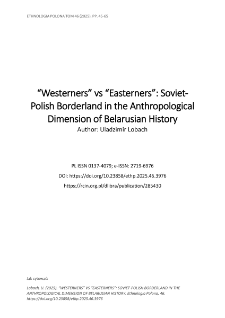
Title: “Westerners” vs “Easterners”: Soviet-Polish Borderland in the Anthropological Dimension of Belarusian History
Publisher:
Institute of Archaeology and Ethnology Polish Academy of Sciences
Place of publishing:
Description:
Type of object:
Abstract:
This article deals with the phenomenon of the Soviet-Polish border in Belarus in 1921–1939 as a factor that influenced the regional identity construction and development of mutual stereotypes among the Belarusians who found themselves within the Polish state and within the Belarusian Soviet Socialist Republic (BSSR). Particular attention is paid to the analysis of oral history materials recorded in 2000–2010 in the area of the former Soviet-Polish borderland. The geopolitical rift of the ethnic territory and the low level of Belarusians’ national identity became the basis for new forms of identity of the population of Western and Eastern Belarus (“Westerners” and “Easterners”). During the functioning of the Soviet-Polish border, the mutual representations of “Westerners” and “Easterners” are vague and are shaped mainly by state ideology and propaganda, where the image of an external “enemy” prevails. A detailed filling of the images of “Westerners” and “Easterners” with social, economic, and ethnocultural characteristics occurs after the physical (1939) and actual (1944) elimination of the Soviet-Polish border. During the Nazi occupation (1941–1944), and especially in the post-war years, communication between the population of Western and Eastern Belarus became intense. The massive labour migration, as well as the flows of beggars from the devastated areas to the relatively prosperous Western region of the country in the early postwar years, also signified the formation of informational flows in both directions. According to the author, mutual stereotypical ideas of “Westerners” and “Easterners” were finally formed after the end of the Second World War. The core of these ideas is the antinomy of “prosperity–poverty”, as well as a set of related connotations: “individual farmer–collective farmer”, “hardworking–idler”, “believer–atheist”, “policeman–partisan", “individualist–collectivist” and “secretive–communicative”.
References:
Engelking, Anna. 2012. Kołchoźnicy. Antropologiczne studium tożsamości wsi białoruskiej przełomu XX i XXI wieku. Toruń: Wyd. Naukowe UMK.
Golubev, Aleksandr. 2019. “Inokul’turnye predstavleniya v rossiyskoy istorii”. In «Svoy» / «Chuzhoy» v kross-kul’turnych kommunikacyjach stran Zapada i Rossii. “Obraz vraga”, edited by Tat’yana Labutina, 98–126. St Petersburg: Aleteya.
Ivanova, Voĺha. 2015. “Zachodniki” i “ŭschodniki” va ŭspaminach žycharoŭ byloha saviecka-poĺskaha pahraničča” In Vosień 1939 hoda ŭ histaryčnaj tradycyi i vusnaj historii, edited by Alieś Smaliančuk, 81–94. Minsk : Zmicier Kolas.
Ivanova, Voĺha. 2018. Pramoŭlienaja historyja: XX st. u pamiaci žycharoŭ bielaruskaj vioski. Minsk: Zmicier Kolas.
Kasciuk, Michail, et al. 1995. Narysy historyi Bielarusi: Part 2. Minsk: Bielaruś.
Kolosov, Vladimir. 2017. “Fantomnyye granitsy kak fenomen politicheskoy geografii”. Vestnik Moskovskogo universiteta, Series 5. Geography 5: 3–11.
Kuz’mich, Valentina. 2019. “Nelegal’nyy tovarooborot na belorusskom uchastke sovetsko-pol’skoy granitsy v 1921–1939 gg”. In Sistemnaya transformatsiya obshchestva: informatsionnyye tekhnologii, innovatsii i traditsii. Sbornik nauchnykh trudov, edited by Veronika Varich, 56–59. Brest: BrGTU.
Lotman, Yuriy. 1996. Vnutri myslyashchikh mirov. Chelovek – tekst – semiosfera – istoriya. Moskva: Yаzyki russkoy kul’tury.
Lotman, Yuriy. 2001. Semiosfera. St Petersburg: Iskusstvo-SPB.
Maźko, Eduard. 2009. “Zachodniaja Bielaruś vačyma žycharoŭ uschodu Bielarusi”. ARCHE 8: 337–365.
Musial, Bohdan. 2018. Savieckija partyzany ŭ 1941–1944 hh. Mify i rečaisnasć. Smaliensk: Inbielkuĺt.
Naščyniec, Kanstancin. 2018. “Kantrabanda jak sacyjaĺnaja zjava. Dasliedavannie prabliemy ŭ 1921–1939 hadach”. Bielaruskaja dumka 1: 91–97.
Pakholova, Irina. 2011. “Gostepriimstvo bezotvetnogo dara kak sotsiokul’turnyy opyt «chuzhogo»”. Mezhdunarodnyy zhurnal issledovaniy kul’tury 1: 32–38.
Pokrovskiy, Nikolaj (ed.). 2006. Politbyuro i krest’yanstvo: vysylka, spetsposeleniye. 1930–1940. Part 2. Moskva: ROSSPEN.
Radziuk, Aliaksiej. 2008. “Saviecka-poĺskaja miaža ŭ kaliektyŭnaj pamiaci bielaruskaha nasieĺnictva Dokšyckaha rajonu”. ARCHE 8: 97–114.
Repina, Lorina. 2011. Istoricheskaya nauka na rubezhe ХХ–ХХІ vv. Sotsial’nyye teorii i istoriograficheskaya praktika. Moskva: Krug.
Smaliančuk, Alieś. 2015. “Vierasień 1939 hoda jak miesca pamiaci bielarusaŭ”. In Vosień 1939 hoda ŭ histaryčnaj tradycyi i vusnaj historii, edited by Alieś Smaliančuk, 11–21. Minsk: Zmicier Kolas.
Smaliančuk, Alieś (ed.). 2015. Vosień 1939 hoda ŭ histaryčnaj tradycyi i vusnaj history. Minsk: Zmicier Kolas.
Smaliančuk, Alieś (ed.). 2019. “Za pieršymi savietami”: poĺska-bielaruskaje pamiežža 1939–1941 hh. u vusnych uspaminach žycharoŭ Bielarusi. Minsk: Zmicier Kolas.
Smułkowa, Elżbieta. 2016. Moje pogranicza w historii, języku i wspomnieniach. Warszawa: Slawistyczny Ośrodek Wydawniczy Instytutu Slawistyki PAN.
Stoŭn, Lorens. 2008. “Viartannie naratyvu”. In Budučynia historyi: zb. artykulaŭ pa sučasnaj histaryjahrafii, edited by Hienadź Sahanovič, 5–28. Minsk: Miedysont.
Šliubski, Alieś. 1927. Matarjaly da vyvučennia faĺkloru i movy Viciebščyny. Part 1. Minsk: Instytut Bielaruskaj kuĺtury.
Vabishchevich, Aleksandr. 2011. “Zapadnoukrainskiye i Zapadnobelorusskiye zemli nakanune vtoroy mirovoy voyny”. In Zapadnaya Belorussiya i Zapadnaya Ukraina v 1939–1941 gg.: lyudi, sobytiya, dokumenty, edited by Oksana Petrovskaya and Elena Borisenok, 7–24. St Petersburg: Aleteya.
Yelenskaya, Irina. 2011. “Sobytiya 1939–1941 godov v zapadnykh oblastyakh Belorussii: ustnaya istoriya”. In Zapadnaya Belorussiya i Zapadnaya Ukraina v 1939–1941 gg.: lyudi, sobytiya, dokumenty, edited by Oksana Petrovskaya and Elena Borisenok, 103–120. St Petersburg: Aleteya.
Relation:
Volume:
Start page:
End page:
Detailed Resource Type:
Format:
Resource Identifier:
oai:rcin.org.pl:248532 ; 0137-4079 ; eISSN 2719-6976 ; doi:10.23858/ethp.2025.46.3976
Source:
IAiE PAN, call no. P 366 ; IAiE PAN, call no. P 367 ; IAiE PAN, call no. P 368 ; click here to follow the link
Language:
Rights:
Creative Commons Attribution BY-NC-ND 4.0 license
Terms of use:
Copyright-protected material. [CC BY-NC-ND 4.0] May be used within the scope specified in Creative Commons Attribution BY-NC-ND 4.0 license, full text available at: ; -
Digitizing institution:
Institute of Archaeology and Ethnology of the Polish Academy of Sciences
Original in:
Library of the Institute of Archaeology and Ethnology of the Polish Academy of Sciences
Access:
Object collections:
- Digital Repository of Scientific Institutes > Partners' collections > Institute of Archeology and Ethnology PAS
- Digital Repository of Scientific Institutes > Partners' collections > Institute of Archeology and Ethnology PAS > Institute Publications
- Digital Repository of Scientific Institutes > Partners' collections > Institute of Archeology and Ethnology PAS > Institute Publications > Current Journals
- Digital Repository of Scientific Institutes > Literature
- Digital Repository of Scientific Institutes > Literature > Journals/Articles
- Digital Repository of Scientific Institutes > Partners' collections > Institute of Archeology and Ethnology PAS > Institute Publications > Current Journals > Ethnologia Polona
Last modified:
Feb 25, 2026
In our library since:
Feb 25, 2026
Number of object content downloads / hits:
16
All available object's versions:
https://www.rcin.org.pl/publication/285430
Show description in RDF format:
Show description in RDFa format:
Show description in OAI-PMH format:
Objects Similar
Zibrova, Ekaterina
Dinerstein, Anton Sandel, Todd
Sadowska, Zuzanna
Bielenin-Lenczowska, Karolina
Hryciuk, Renata E. Król, Katarzyna E.