- About project
- Collections
- Indexes
- Recently viewed
-
RCIN Repositories
-
 INSTYTUT ARCHEOLOGII I ETNOLOGII POLSKIEJ AKADEMII NAUK
-
 INSTYTUT BADAŃ LITERACKICH POLSKIEJ AKADEMII NAUK
-
 INSTYTUT BADAWCZY LEŚNICTWA
-
 INSTYTUT BIOLOGII DOŚWIADCZALNEJ IM. MARCELEGO NENCKIEGO POLSKIEJ AKADEMII NAUK
-
 INSTYTUT BIOLOGII SSAKÓW POLSKIEJ AKADEMII NAUK
-
 INSTYTUT CHEMII FIZYCZNEJ PAN
-
 INSTYTUT CHEMII ORGANICZNEJ PAN
-
 INSTYTUT FILOZOFII I SOCJOLOGII PAN
-
 INSTYTUT GEOGRAFII I PRZESTRZENNEGO ZAGOSPODAROWANIA PAN
-
 INSTYTUT HISTORII im. TADEUSZA MANTEUFFLA POLSKIEJ AKADEMII NAUK
-
 INSTYTUT JĘZYKA POLSKIEGO POLSKIEJ AKADEMII NAUK
-
 INSTYTUT MATEMATYCZNY PAN
-
 INSTYTUT MEDYCYNY DOŚWIADCZALNEJ I KLINICZNEJ IM.MIROSŁAWA MOSSAKOWSKIEGO POLSKIEJ AKADEMII NAUK
-
 INSTYTUT PODSTAWOWYCH PROBLEMÓW TECHNIKI PAN
-
 INSTYTUT SLAWISTYKI PAN
-
 SIEĆ BADAWCZA ŁUKASIEWICZ - INSTYTUT TECHNOLOGII MATERIAŁÓW ELEKTRONICZNYCH
-
 MUZEUM I INSTYTUT ZOOLOGII POLSKIEJ AKADEMII NAUK
-
 INSTYTUT BADAŃ SYSTEMOWYCH PAN
-
 INSTYTUT BOTANIKI IM. WŁADYSŁAWA SZAFERA POLSKIEJ AKADEMII NAUK
-
- Search in all Repository
- Literature and maps
- Archeology
- Mills database
- Natural sciences
Advanced search
Advanced search
Advanced search
Advanced search
Advanced search

Object
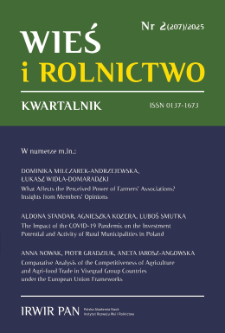
Title: What Affects the Perceived Power of Farmers’ Associations? Insights from Members’ Opinions
Creator:
Milczarek-Andrzejewska, Dominika
 ;
Widła-Domaradzki, Łukasz
Date issued/created:
Resource type:
Publisher:
Polska Akademia Nauk. Instytut Rozwoju Wsi i Rolnictwa
Place of publishing:
Type of object:
References:
Barney J.B., Ketchen D.J., Wright M. (2011). The future of resource-based theory: Revitalization or decline? Journal of Management, 37(5), 1299–1315. DOI:10.1177/0149206310391805.
Baumgartner F.R., Berry J.M., Hojnacki M., Kimball D.C., Leechet B.L. (2009). Lobbying and Policy Change: Who Wins, Who Loses, and Why. Chicago: Chicago University Press.
Bavorova M., Curtiss J., Jelinek L. (2005). Czech Agricultural Associations and the Impact of Membership on Farm Efficiency. Paper presented at the 94th EAAE Seminar “From Households to Firms with Independent Legal Status: The Spectrum of Institutional Units in the Development of European Agriculture”.
Bayard B., Jolly C. (2007). Environmental behavior structure and socio-economic conditions of hillside farmers: A multiple-group structural equation modeling approach. Ecological Economics, 62(3–4), 433–440. DOI:10.1016/j.ecolecon.2006.07.004.
Bednaříková Z., Jílková J. (2012). Why is the agricultural lobby in the European Union member states so effective? E a M: Ekonomie a Management, 15(2), 26–37.
Beyers J. (2004). Voice and access: Political practices of European interest associations. European Union Politics, 5(2), 211–240. DOI:10.1177/1465116504042442.
Bilewicz A. (2020). Beyond the modernisation paradigm: Elements of a food sovereign-ty discourse in farmer protest movements and alternative food networks in Poland. Sociologia Ruralis, 60(4), 754–772. DOI:10.1111/soru.12295.
Bilewicz A., Mamonova N., Burdyka K. (2022). “Paradoxical” dissatisfaction among post- -socialist farmers with the EU’s Common Agricultural Policy: A study of farmers’ subjectivities in rural Poland. East European Politics and Societies, 36(3), 892–912. DOI:10.1177/08883254211036717.
Binderkrantz A.S., Christiansen P.M., Pedersen H.H. (2015). Interest group access to the bureaucracy, parliament, and the media. Governance, 28(1), 95–112. DOI:10.1111/gove.12089.
Binderkrantz A.S., Rasmussen A. (2015). Comparing the domestic and the EU lobbying context: Perceived agenda-setting influence in the multi-level system of the European Union. Journal of European Public Policy, 22(4), 552–569. DOI:10.1080/13501763.20 15.1008553.
Crombois J.F. (2019). Central and Eastern European business interest associations and EU policy making. Journal of Public Affairs, 19(1), 1–8. DOI:10.1002/pa.1827.
Daxecker U., Di Salvatore J., Ruggeri A. (2019). Fraud is what people make of it: Election fraud, perceived fraud, and protesting in Nigeria. Journal of Conflict Resolution, 63(9), 2098–2127. DOI:10.1177/0022002718824636.
Deininger K. (2003). Land markets in developing and transition economies: Impact of li-beralization and implications for future reform. American Journal of Agricultural Economics, 85(5), 1217–1222. DOI:10.1111/j.0092-5853.2003.00533.x.
Dobbins M., Horvath B., Labanino R.P. (2022). Exploring the domestic and internatio-nal drivers of professionalization of Central and Eastern European interest groups. European Political Science Review, 14(2), 263–280. DOI:10.1017/S1755773922000054.
Dür A. (2008a). Interest groups in the European Union: How powerful are they? West European Politics, 31(6), 1212–1230. DOI:10.1080/01402380802372662.
Dür A. (2008b). Measuring interest group influence in the EU: A note on methodology. European Union Politics, 9(4), 559–576. DOI: 10.1177/1465116508095151.
Dür A., Bernhagen P., Marshall D. (2015). Interest group success in the European Union: When (and why) does business lose? Comparative Political Studies, 48(8), 951–983. DOI:10.1177/0010414014565890.
Eising R. (2017). Studying interest groups: methodological challenges and tools. European Political Science, 16(3), 291–305. DOI:10.1057/eps.2016.14.
Eising R., Rasch D., Rozbicka P. (2017). National interest organisations in EU policy-ma-king. West European Politics, 40(5), 939–956. DOI:10.1080/01402382.2017.1320174.
Evanson R.K. (2008). Economic interest groups and the consolidation of democracy in the Czech Republic. Journal of Public Affairs, 8(1/2), 33–49. DOI:10.1002/pa.283.
Fałkowski J. (2018). Together we stand, divided we fall? Smallholders’ access to political power and their place in Poland’s agricultural system. Journal of Agrarian Change, 18(4), 893–903. DOI:10.1111/joac.12278.
Fałkowski J., Chlebicka A., Łopaciuk-Gonczaryk B. (2017). Social relationships and go-verning collaborative actions in rural areas: Some evidence from agricultural pro-ducer groups in Poland. Journal of Rural Studies, 49, 104–116. DOI:10.1016/j.jrur-stud.2016.11.010.
Fałkowski J., Malak-Rawlikowska A., Milczarek-Andrzejewska D. (2017). Farmers’ self--reported bargaining power and price heterogeneity: Evidence from the dairy supply chain. British Food Journal, 119(8), 1672–1686. DOI:10.1108/BFJ-11-2016-0570.
Feng H., Wang T., Hennessy D.A., Arora G. (2022). Over-perception about land use changes: Assessing empirical evidence and linkage with decisions and motivated beliefs. Land Economics, 98(2), 254–273. DOI:10.3368/le.98.2.040920-0052R.
Finger R., Fabry A., Candel J., Dalhaus T., Meemken E.M. (2024). Farmer protests in Europe 2023–2024. EuroChoices, 23(3), 59–63. DOI:10.1111/1746-692X.12452.
Fischer C., Hartmann M., Bavorova M., Hockmann H., Suvanto H., Viitaharju L., Leat P., Revoredo-Giha C., Henchion M., McGee C., Dybowski G., Kobuszynska M. (2008). Business relationships and B2B communication in selected European agri-food chains – first empirical evidence. International Food and Agribusiness Management Review, 11(2), 73–100.
Foryś G. (2021). Dynamics of changes in the farmers’ contestation in Poland in 1989– 2018. In: P. Pospěch, E.M. Fuglestad, E. Figueiredo (eds.). Politics and Policies of Rural Authenticity (pp. 170–186). London: Routledge. DOI:10.4324/9781003091714.
Foryś G. (2008). Z badań nad protestami rolniczymi w Polsce. Wieś i Rolnictwo, 4(141), 9–28.
Gorton M., Angell R., Dries L., Urutyan V., Jackson E., White J. (2015). Power, buyer tru-stworthiness and supplier performance: Evidence from the Armenian dairy sector. Industrial Marketing Management, 50, 69–77. DOI:10.1016/j.indmarman.2015.05.024.
Grossman G.M., Helpman E. (2001). Special Interest Politics. Cambridge: MIT Press.
Hagedorn K. (2014). Post-socialist farmers’ cooperatives in Central and Eastern Europe. Annals of Public and Cooperative Economics, 85(4), 555–577. DOI:10.1111/apce.12051.
Hajdu A., Mamonova N. (2020). Prospects of agrarian populism and food sovereignty movement in post-socialist Romania. Sociologia Ruralis, 60(4), 880–904. DOI:10.1111/soru.12301.
Halamska M. (2008). Organizacje rolników: bilans niesentymentalny. In: M. Halamska (ed.). Wiejskie organizacje pozarządowe (pp. 103–133). Warszawa: Instytut Rozwoju Wsi i Rolnictwa PAN.
Hanegraaff M., Pritoni A. (2019). United in fear: Interest group coalition formation as a weapon of the weak? European Union Politics, 20(2), 198–218. DOI:10.1177/1465116518824022.
Hoyle R.H. (ed.). (1995). Structural Equation Modeling: Concepts, Issues, and Applications. Thousand Oaks, CA: Sage Publications.
Jambor A., Gorton M. (2025). Twenty years of EU accession: Learning lessons from Central and Eastern European agriculture and rural areas. Agricultural and Food Economics, 13(1), 1–17. DOI:10.1186/s40100-025-00346-w.
Kaine G., Wright V. (2024). Social desirability bias and the prevalence of self-reported conservation behaviour among farmers. Sustainability, 16(22), 9658. DOI:10.3390/su16229658.
Klüver H. (2020). The survival of interest groups: Evidence from Germany. West European Politics, 43(7), 1436–1454. DOI:10.1080/01402382.2019.1662634.
Klüver H. (2013). Lobbying in the European Union: Interest Groups, Lobbying Coalitions, and Policy Change. Oxford: Oxford University Press.
Klüver H. (2011). The contextual nature of lobbying: Explaining lobbying success in the European Union. European Union Politics, 12(4), 483–506. DOI:10.1177/ 1465116511413163.
Klüver H. (2010). Europeanization of lobbying activities: When national interest gro-ups spill over to the European level. Journal of European Integration, 32(2), 175–191. DOI:10.1080/07036330903486037.
Kohler-Koch B., Kotzian P., Quittkat C. (2017). The multilevel interest representation of national business associations. West European Politics, 40(5), 1046–1065. DOI:10.1 080/01402382.2017.1303244.
Lukes S. (2005). Power: A Radical View. Basingstoke: Palgrave Macmillan.
Matthews A. (2024). Farmer protests and the 2024 European Parliament elections. Intereconomics, 59(2), 83–87. DOI:10.2478/ie-2024-0018.
Mennig P. (2024). A never-ending story of reforms: On the wicked nature of the Common Agricultural Policy. npj Sustainable Agriculture, 2(20). DOI:10.1038/s44264-024-00027-z.
Meuwissen M.P.M., Feindt P.H., Garrido A., Mathijs E., Soriano B., Urquhart J., Spiegel A. (eds.). (2022). Resilient and Sustainable Farming Systems in Europe. Cambridge: Cambridge University Press. DOI:10.1017/9781009093569.
Milczarek-Andrzejewska D., Śpiewak R. (2018). Farmers’ associations: Their resources and channels of influence. Evidence from Poland. Sociologia Ruralis, 58(4), 825–845. DOI:10.1111/soru.12207.
Möllers J., Traikova D., Bîrhală B.A.M., Wolz A. (2018). Why (not) cooperate? A cognitive model of farmers’ intention to join producer groups in Romania. Post-Communist Economies, 30(1), 56–77. DOI:10.1080/14631377.2017.1361697.
Mroczkowska J. (2022). Trapped in the grey zones: Voicing discontent and strategies of re-sistance in rural Poland. Ethnologia Polona, 43. DOI:10.23858/ethp.2022.43.3140.
Müller M., Rommel J. (2018). Should i stay or should i go? A behavioral approach to or-ganizational choice in Tajikistan’s agriculture. Journal of Agricultural and Resource Economics, 43(3), 469–486.
Nedergaard P. (2006). Market failures and government failures: A theoretical model of the common agricultural policy. Public Choice, 127(3–4), 393–413. DOI:10.1007/s11127-005-9000-1.
Novak M., Lajh D. (2024). New kids on the democracy block: Europeanisation of interest groups in Central and Eastern Europe. Politics and Governance, 12, 7512. DOI:10.17645/pag.7512.
Pecorino P. (2015). Olson’s logic of collective action at fifty. Public Choice, 162(3–4), 243–262. DOI:10.1007/s11127-014-0186-y.
Rausser G.C., Swinnen J., Zusman P. (2011). Political Power and Economic Policy: Theory, Analysis and Empirical Applications. Cambridge: Cambridge University Press.
Ritzel C., Mack G., Portmann M., Heitkämper K., El Benni N. (2020). Empirical evidence on factors influencing farmers’ administrative burden: A structural equation modeling approach. PLoS ONE, 15(10), 1–16. DOI:10.1371/journal.pone.0241075.
Rosner A., Stanny M. (2017). Socio-economic Development of Rural Areas in Poland. Warszawa: Fundacja Europejski Fundusz Rozwoju Wsi Polskiej (EFRWP)–Instytut Rozwoju Wsi i Rolnictwa PAN.
Salhofer K., Hofreither M.F., Sinabell F. (2000). Promotion of the agricultural sector and politi-cal power in Austria. Public Choice, 102(3–4), 229–246. DOI:10.1023/A:1005024920319.
Sander A., Ghazoul J., Finger R., Schaub S. (2024). Participation in individual and collective agri-environmental schemes: A synthesis using the theory of planned behaviour. Journal of Rural Studies, 107, 103255, DOI:10.1016/j.jrurstud.2024.103255.
Sok J., Hogeveen H., Elbers A.R.W., Oude Lansink A.G.J.M. (2015). Farmers’ beliefs and voluntary vaccination schemes: Bluetongue in Dutch dairy cattle. Food Policy, 57, 40–49. DOI:10.1016/j.foodpol.2015.09.006.
Sokoli O., Xhoxhi O., Skreli E., Imami D., Doluschitz R. (2021). Willingness to coope-rate in the context of post-communist economy: Why do local rules matter? World Development Perspectives, 22, 100314. DOI:10.1016/j.wdp.2021.100314.
Stevens F., De Bruycker I. (2020). Influence, affluence and media salience: Economic reso-urces and lobbying influence in the European Union. European Union Politics, 21(4), 728–750. DOI:10.1177/1465116520944572.
Swinnen J. (2018). The Political Economy of Agricultural and Rural Development. New York: Palgrave Macmillan. DOI:10.1057/978-1-137-50102-8.
Śpiewak R., Milczarek-Andrzejewska D., Ciechomska A. (2016). Agricultural organiza-tions in Poland – an attempt towards a typology. Journal of Agribusiness and Rural Development, 4(42), 659–668. DOI:10.17306/jard.2016.92.
Van Winden F. (2004). Interest group behavior and influence. In: C.K. Rowley, F. Schneider (eds.). The Encyclopedia of Public Choice (pp. 118–129). Boston: Springer. DOI:10.1007/978-0-306-47828-4_10.
Veitch A. (2025). Unions out of their league? Ethnographic insights into the 2024 French farmer protests. The Journal of Peasant Studies, 1–19. DOI:10.1080/03066150.2025.2 457081
Weiler F., Reißmann J. (2019). Interest group coalitions: How the intensity of coopera-tion affects the choice of lobbying strategies. Interest Groups & Advocacy, 8, 91–119. DOI:10.1057/s41309-019-00047-y.
Wolz A., Fritzsch J., Reinsberg K. (2006). The impact of social capital on Polish farm incomes: Findings of an empirical survey. Post-Communist Economies, 18(1), 85–99. DOI:10.1080/14631370500505347.
Woods M., Anderson J., Guilbert S., Watkin S. (2012). ‘The country(side) is angry’: Emotion and explanation in protest mobilization. Social & Cultural Geography, 13(6), 567–585. DOI:10.1080/14649365.2012.704643.
Yao M., Xu Y. (2024). Method bias mechanisms and procedural remedies. Sociological Methods & Research, 53(1), 235–278. DOI:10.1177/00491241211043141.
Żuk P. (2025). The European Green Deal and the peasant cause: Class frustration, cultural backlash and right-wing nationalist populism in farmers’ protests in Poland. Journal of Rural Studies, 119, 103708, DOI:10.1016/j.jrurstud.2025.103708.
Relation:
Start page:
End page:
Detailed Resource Type:
Resource Identifier:
Source:
Language:
Language of abstract:
Rights:
Creative Commons Attribution BY 4.0 license
Terms of use:
Digitizing institution:
Institute of Rural and Agricultural Development of the Polish Academy of Sciences
Original in:
Library of the Institute of Rural and Agriculture Development of the PAS
Projects co-financed by:
Access:
Object collections:
- Digital Repository of Scientific Institutes > Literature > Journals/Articles
- Digital Repository of Scientific Institutes > Partners' collections > Institute of Rural and Agricultural Development PAS > Scientific Journals
Last modified:
Jul 15, 2026
In our library since:
Jul 15, 2026
Number of object content downloads / hits:
29
All available object's versions:
https://www.rcin.org.pl/publication/300199
Show description in RDF format:
Show description in RDFa format:
Show description in OAI-PMH format:
| Edition name | Date |
|---|---|
| Milczarek-Andrzejewska, Dominika, What Affects the Perceived Power of Farmers’ Associations? Insights from Members’ Opinions | Jul 15, 2026 |
Objects Similar
Milczarek-Andrzejewska, Dominika Śpiewak, Ruta
Milczarek-Andrzejewska, Dominika Czarnecki, Adam
Zawalińska, Katarzyna Wilkin, Jerzy Milczarek-Andrzejewska, Dominika
Malak-Rawlikowska, Agata Milczarek-Andrzejewska, Dominika
Milczarek-Andrzejewska, Dominika Malak-Rawlikowska, Agata