- About project
- Collections
- Indexes
- Recently viewed
-
RCIN Repositories
-
 INSTYTUT ARCHEOLOGII I ETNOLOGII POLSKIEJ AKADEMII NAUK
-
 INSTYTUT BADAŃ LITERACKICH POLSKIEJ AKADEMII NAUK
-
 INSTYTUT BADAWCZY LEŚNICTWA
-
 INSTYTUT BIOLOGII DOŚWIADCZALNEJ IM. MARCELEGO NENCKIEGO POLSKIEJ AKADEMII NAUK
-
 INSTYTUT BIOLOGII SSAKÓW POLSKIEJ AKADEMII NAUK
-
 INSTYTUT CHEMII FIZYCZNEJ PAN
-
 INSTYTUT CHEMII ORGANICZNEJ PAN
-
 INSTYTUT FILOZOFII I SOCJOLOGII PAN
-
 INSTYTUT GEOGRAFII I PRZESTRZENNEGO ZAGOSPODAROWANIA PAN
-
 INSTYTUT HISTORII im. TADEUSZA MANTEUFFLA POLSKIEJ AKADEMII NAUK
-
 INSTYTUT JĘZYKA POLSKIEGO POLSKIEJ AKADEMII NAUK
-
 INSTYTUT MATEMATYCZNY PAN
-
 INSTYTUT MEDYCYNY DOŚWIADCZALNEJ I KLINICZNEJ IM.MIROSŁAWA MOSSAKOWSKIEGO POLSKIEJ AKADEMII NAUK
-
 INSTYTUT PODSTAWOWYCH PROBLEMÓW TECHNIKI PAN
-
 INSTYTUT SLAWISTYKI PAN
-
 SIEĆ BADAWCZA ŁUKASIEWICZ - INSTYTUT TECHNOLOGII MATERIAŁÓW ELEKTRONICZNYCH
-
 MUZEUM I INSTYTUT ZOOLOGII POLSKIEJ AKADEMII NAUK
-
 INSTYTUT BADAŃ SYSTEMOWYCH PAN
-
 INSTYTUT BOTANIKI IM. WŁADYSŁAWA SZAFERA POLSKIEJ AKADEMII NAUK
-
- Search in all Repository
- Literature and maps
- Archeology
- Mills database
- Natural sciences
Advanced search
Advanced search
Advanced search
Advanced search
Advanced search

Object
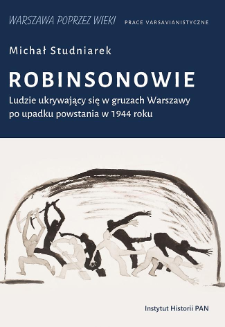
Title: Robinsonowie : ludzie ukrywający się w gruzach Warszawy po upadku powstania w 1944 roku
Subtitle:
History and Fate of the Robinson Crusoes of Warsaw ; Warszawa Poprzez Wieki : prace varsavianistyczne. Monographia ; 1
Institutional creator:
Polska Akademia Nauk. Instytut Historii im. Tadeusza Manteuffla

Publisher:
Place of publishing:
Description:
Wydanie I ; 382 pages, [1] folded chart : illustrations (some color) ; 25 cm ; One folded map inside cover ; Appendix: List of "Robinsons" with location of hiding places and sources of information noted ; Bibliography (pages 248-261). Indeks ; The task financed from the funds of the Ministry of Education and Science of the Republic of Poland MEiN/2022/DPI/449, Action B ; Summary in English
Abstract:
The book is devoted to the survival of people in Warsaw’s ruins after the fall of the Uprising from October 1944 to January 1945. The so-called Robinson Crusoes (or Robinsons) of Warsaw were the people who remained hidden in ruins after the failed Warsaw Uprising (1 August – 2 October 1944) and the city’s subsequent destruction by the Germans. The book is based mainly on the accounts and recollections of the Robinsons but also on the studies and press articles published after the war. It also presents the current state of research and a survey of source literature. Thea uthor attempts to define who could be called a Robinson Crusoe of Warsaw and to characterise this group. He also tries to determine their number on the basis of collected memoirs and archival material. Starting from the description of the city’s situation after the Uprising’s capitulation, the author presents the conditions determining the decision to hide, then the selection and the preparation of the hiding place. In the subsequent chapters, the author discusses the living conditions of the Robinsons – how they perceived their hiding places and their own person locked in them (according to Marta Cobel-Tokarska), how they organised their life, acquired food, water and other necessities during organised night-time trips, how the hiding places were heated, how they coped with falling snow or the problem of having weapons. Considering the long periods in the hideout, it was essential to idle away the dragging time, so the ways of spending free time are described. Equally important were the relationships between individual members in the group (sometimes it was agreed who was the group’s leader and a division of tasks was introduced) and between groups, as it was not unusual to meet outside other Robinsons. There were also encounters with people from outside the German cordon surrounding Warsaw, who sneaked in to loot in ruins or with forced labourers cleaning the streets. Although everyone avoided it, there were also encounters with Germans. The Robinsons also made successful attempts to leave the destroyed city. In the next part of the book, the author describes the post-war fate of the Robinsons; he also analyses how the media and the public depicted, recorded and passed on the memory of the Robinsons’ fate. Next, he presents how the Robinsons perceived their life in hiding years later and the significance of this period compared to other events of their lives; he also describes how the hiding impacted their bodies and psyches. In conclusion, the author discusses the importance of hiding for the symbolic continuity of the city’s habitation. Survival posed a substantial challenge to the Robinsons’ psyche, their ingenuity and their ability to improvise. It is a testimony to the people’s immense will to survive and their perseverance in overcoming obstacles. The work includes an alphabetical list of the Robinsons mentioned in the sources and two maps of Warsaw with the Robinsons’ hiding places marked. Most of the people in hiding, about 1,100, were civilians, with almost half of Jewish descent.
Relation:
Warszawa Poprzez Wieki. Monographia
Volume:
Detailed Resource Type:
Resource Identifier:
oai:rcin.org.pl:238152 ; 978-83-66911-37-6
Source:
IH PAN, call no. II.15890 Podr. ; IH PAN, call no. II.15891 ; click here to follow the link
Language:
Language of abstract:
Rights:
Creative Commons Attribution BY-ND 4.0 license
Terms of use:
Copyright-protected material. [CC BY-ND 4.0] May be used within the scope specified in Creative Commons Attribution BY-ND 4.0 license, full text available at: ; -
Digitizing institution:
Institute of History of the Polish Academy of Sciences
Original in:
Library of the Institute of History PAS
Projects co-financed by:
Ministry of Education and Science
Access:
Object collections:
- Digital Repository of Scientific Institutes > Partners' collections > Institute of History PAS
- Digital Repository of Scientific Institutes > Partners' collections > Institute of History PAS > Books
- Digital Repository of Scientific Institutes > Partners' collections > Institute of History PAS > Institute Publications
- Digital Repository of Scientific Institutes > Partners' collections > Institute of History PAS > Institute Publications > Books
- Digital Repository of Scientific Institutes > Literature
- Digital Repository of Scientific Institutes > Literature > Books/Chapters
Last modified:
Oct 3, 2025
In our library since:
Apr 11, 2023
Number of object content downloads / hits:
1 874
All available object's versions:
https://www.rcin.org.pl/publication/274526
Show description in RDF format:
Show description in RDFa format:
Show description in OAI-PMH format:
| Edition name | Date |
|---|---|
| Studniarek, Michał (1976– ), Robinsonowie : ludzie ukrywający się w gruzach Warszawy po upadku powstania w 1944 roku | Oct 3, 2025 |
Objects Similar
Dunin-Wąsowicz, Krzysztof (1923–2013)
Grygierczyk, Miłosz
Bakunowicz, Czesław
Strzembosz, Tomasz (1930–2004)