- About project
- Collections
- Indexes
- Recently viewed
-
RCIN Repositories
-
 INSTYTUT ARCHEOLOGII I ETNOLOGII POLSKIEJ AKADEMII NAUK
-
 INSTYTUT BADAŃ LITERACKICH POLSKIEJ AKADEMII NAUK
-
 INSTYTUT BADAWCZY LEŚNICTWA
-
 INSTYTUT BIOLOGII DOŚWIADCZALNEJ IM. MARCELEGO NENCKIEGO POLSKIEJ AKADEMII NAUK
-
 INSTYTUT BIOLOGII SSAKÓW POLSKIEJ AKADEMII NAUK
-
 INSTYTUT CHEMII FIZYCZNEJ PAN
-
 INSTYTUT CHEMII ORGANICZNEJ PAN
-
 INSTYTUT FILOZOFII I SOCJOLOGII PAN
-
 INSTYTUT GEOGRAFII I PRZESTRZENNEGO ZAGOSPODAROWANIA PAN
-
 INSTYTUT HISTORII im. TADEUSZA MANTEUFFLA POLSKIEJ AKADEMII NAUK
-
 INSTYTUT JĘZYKA POLSKIEGO POLSKIEJ AKADEMII NAUK
-
 INSTYTUT MATEMATYCZNY PAN
-
 INSTYTUT MEDYCYNY DOŚWIADCZALNEJ I KLINICZNEJ IM.MIROSŁAWA MOSSAKOWSKIEGO POLSKIEJ AKADEMII NAUK
-
 INSTYTUT PODSTAWOWYCH PROBLEMÓW TECHNIKI PAN
-
 INSTYTUT SLAWISTYKI PAN
-
 SIEĆ BADAWCZA ŁUKASIEWICZ - INSTYTUT TECHNOLOGII MATERIAŁÓW ELEKTRONICZNYCH
-
 MUZEUM I INSTYTUT ZOOLOGII POLSKIEJ AKADEMII NAUK
-
 INSTYTUT BADAŃ SYSTEMOWYCH PAN
-
 INSTYTUT BOTANIKI IM. WŁADYSŁAWA SZAFERA POLSKIEJ AKADEMII NAUK
-
- Search in all Repository
- Literature and maps
- Archeology
- Mills database
- Natural sciences
Advanced search
Advanced search
Advanced search
Advanced search
Advanced search
Object
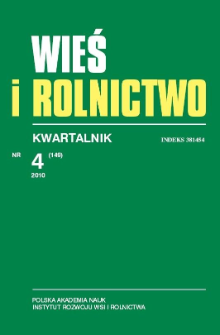
Title: The LEADER programme implementation in Central European countries
Publisher:
Instytut Rozwoju Wsi i Rolnictwa Polskiej Akademii Nauk
Place of publishing:
Type of object:
Abstract:
The implementation of a new European policy based on integrated rural development is an entirely new experiment in the Central European countries, which formerly belonged to the communist system. The paper attempts to explore the conditions and the context in which the Local Development Model is being transferred from the “old” member-states to the new ones, and the methods of its implementation. To examine this issue, we consider the European Union’s Leader programme (an acronym of Liaisons Entre Actions de Développement de l’Economie Rurale) which became the fourth axis of the European Rural Policy (2007-2013). The Leader approach is usually presented as an original way of supporting local development, especially through the Local Action Group (LAG) which is a local body composed of public and private actors. We focus on how this approach is put into effect in three new member states (Czech Republic, Hungary and Poland).Downloading policy to the local communities takes place via various hierarchical modes of governance. Domestic authorities (or transfer operators) transpose and implement European rules and norms which are more flexible than the former development policies. Looking at the main differences between the four countries we explore how the original model is being distorted by domestic institutional factors. Policy transfer processes are not restricted to the ministries of agriculture but involve a wide variety of non-governmental actors mediating the transfer of the model to the local stakeholders who are the acting receivers. The Leader model is experimented in various territorial and social contexts, more or less receptive to this new way of thinking and managing local development.The paper is based on the relevant academic literature, on official national sources and a field research survey. It is a cross-national comparative work that takes into account national and local variations in order to highlight similarities and differences in the transfer of a policy model.
Relation:
Issue:
Start page:
End page:
Resource Identifier:
oai:rcin.org.pl:241869 ; 0137-1673 (print); 2657-5213 (on-line)
Source:
Language:
Language of abstract:
Rights:
Creative Commons Attribution BY 4.0 license
Terms of use:
Digitizing institution:
Institute of Rural and Agricultural Development of the Polish Academy of Sciences
Original in:
Library of the Institute of Rural and Agriculture Development of the PAS
Projects co-financed by:
Access:
Object collections:
- Digital Repository of Scientific Institutes > Literature > Journals/Articles
- Digital Repository of Scientific Institutes > Partners' collections > Institute of Rural and Agricultural Development PAS > Scientific Journals
Last modified:
Dec 17, 2025
In our library since:
Jul 10, 2024
Number of object content downloads / hits:
99
All available object's versions:
https://www.rcin.org.pl/publication/278292
Show description in RDF format:
Show description in RDFa format:
Show description in OAI-PMH format:
| Edition name | Date |
|---|---|
| Program LEADER w krajach Europy Środkowej | Dec 17, 2025 |
Objects Similar
Chevalier, Pascal
Zajda, Katarzyna
Halamska, Maria
Halamska, Maria Michalska, Sylwia Śpiewak, Ruta
Śpiewak, Ruta
Sykała, Łukasz Dej, Magdalena Wolski, Oskar
Lepesant, Gilles